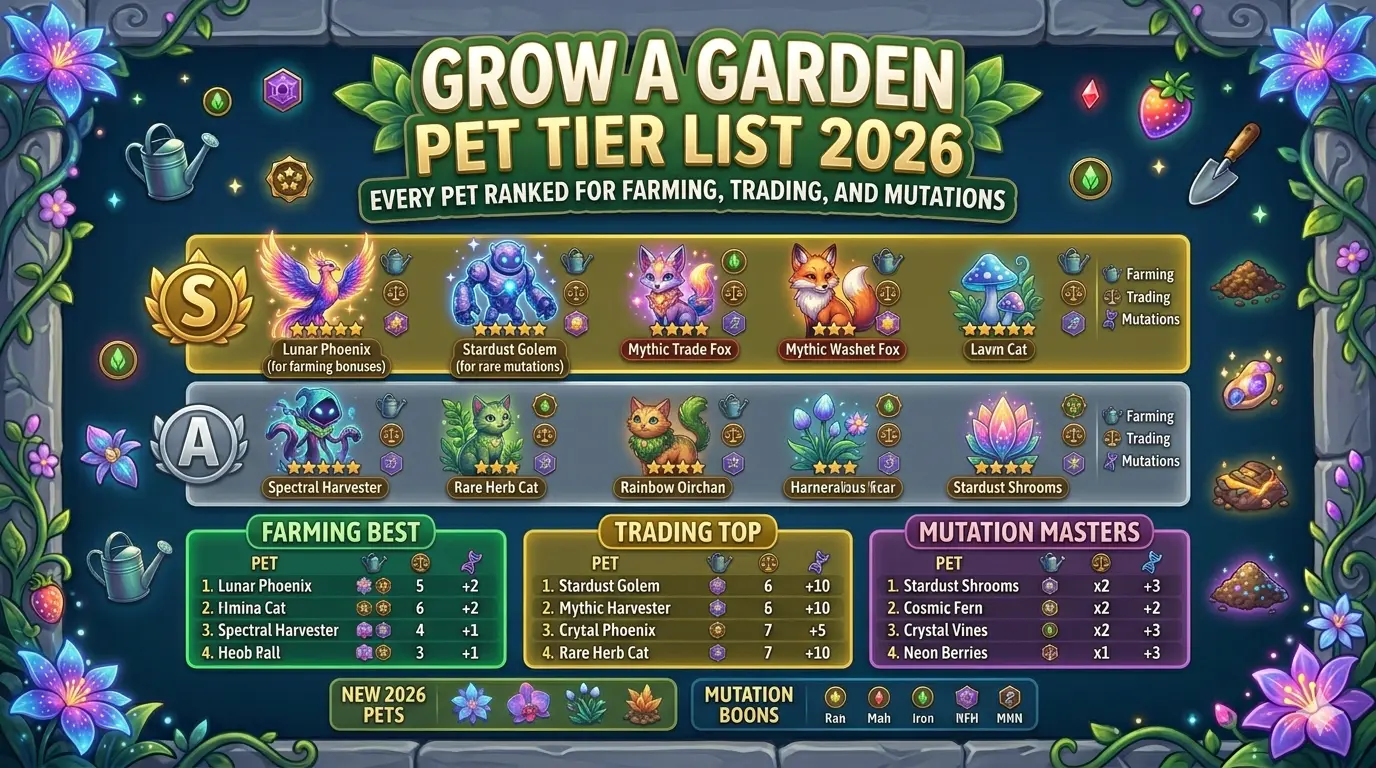
Grow a Garden Pet Tier List 2026 — Every Pet Ranked for Farming, Trading, and Mutations
Picking the right pets in Grow a Garden is one of those decisions that looks simple on the surface and turns out to be surprisingly deep once you start understanding what each ability actually does to your income.
I have been playing this game for three years. I have hatched a lot of eggs, traded a lot of pets, and made the mistake of keeping the wrong ones in my active lineup for longer than I should have. This tier list comes from that experience — not from copying another list, but from actually testing what works and what does not across hundreds of farming sessions.
A few things to understand before we get into the rankings:
Pets are not just cosmetic. Every pet has a passive ability that triggers on a cooldown timer while it roams your garden. The difference between a well-optimised pet lineup and a random one is the difference between passive income and explosive income.
Age and weight matter for trading value. A pet’s trade value is determined primarily by its weight, which increases as it ages from 1 to 125. Two players can own the same pet species and have a 10x value difference based purely on age. For trade value specifically, always use the Pet Weight by Age calculator rather than guessing.
Only your active pets matter for abilities. You can own up to 60 pets (expandable to 135 with pouches), but only the pets in your active lineup trigger their abilities. Fill all 8 active slots with the best pets you have.
Now let us get into the actual rankings.
S Tier — The Best Pets in Grow a Garden
These are the pets that define the endgame. If you have any of these, they should be in your active lineup permanently.
Kitsune and Corrupted Kitsune
There is no debate about this. The Kitsune and Corrupted Kitsune are the most valuable pets in Grow a Garden and it is not particularly close.
Here is why. The Kitsune applies the Chakra mutation (15x) to nearby crops on other players’ farms by copying their fruits. The Corrupted Kitsune applies CorruptChakra (15x) to your own fruits. When both are in your lineup simultaneously, your crops can receive both Chakra and CorruptChakra — which automatically fuses into HarmonisedChakra (35x).
But the rare ability is FoxfireChakra. The Kitsune has a very rare chance to apply FoxfireChakra (90x) instead of standard Chakra. The Corrupted Kitsune has the same rare chance for CorruptFoxfireChakra (90x). When both fire simultaneously on the same crop, they fuse into HarmonisedFoxfireChakra (190x) — one of the highest mutation multipliers available from any source in the game.
The full chain peaks at AscendedChakra (230x), which requires HarmonisedFoxfire and HarmonisedChakra on the same crop simultaneously. On a high-weight exotic crop like Candy Blossom or Suncoil, AscendedChakra produces one of the most valuable harvests possible in Grow a Garden without requiring any admin event.
Why they are S Tier: The mutation ceiling they unlock is unmatched by any other pet. Even at lower proc rates, having both Kitsune and Corrupted Kitsune in your lineup makes every farming session a potential high-multiplier windfall.
How to get them: Both are prismatic rarity pets that can only be obtained from specific eggs tied to their release periods. They are among the rarest pets in the game — most players get them through trading rather than hatching. Use the Grow a Garden Calculator to verify the value of any Kitsune offer before trading for one.
Disco Bee
The Disco Bee is the most accessible S Tier pet and the one most active farmers should be targeting first.
Its ability: every 10 minutes, it has a 20% chance to apply the Disco mutation (125x) to a random fruit in your garden. Over an 8-hour AFK session, that is approximately 48 triggers at 20% success — roughly 9 to 10 Disco mutations applied across your crops while you are offline.
Disco at 125x on a Candy Blossom or Bone Blossom at above-average weight produces fruits worth hundreds of billions of Sheckles. The Disco Bee makes this outcome achievable on a regular basis without requiring an actual Disco admin event to be running.
Why it is S Tier: Consistent access to a 125x mutation through a pet ability changes your farming ceiling entirely. During an actual Disco admin event, Disco Bee and the environmental Disco can apply to different crops simultaneously — doubling your mutation output during the best event windows.
How to get it: Bee Egg, Bee Event rewards. More accessible than Kitsune but still valuable enough to be worth trading for if you do not have one.
Space Squirrel
The Space Squirrel applies Voidtouched (135x) to crops through its passive ability — the same mutation you get from a Blackhole admin event. At 135x, Voidtouched is one of the highest single-mutation multipliers available through a pet.
The additional value is in the combination potential. Voidtouched (135x) + Eclipsed (20x) creates Abyssal (240x), one of the highest combined multipliers in the game. If your server has an Eclipse weather event running while your Space Squirrel is active, watch your crops carefully — any fruit that picks up both mutations simultaneously becomes extraordinarily valuable.
Why it is S Tier: On-demand access to 135x through a pet ability, with a combination ceiling of 240x when Eclipse weather overlaps. Very few pets offer this level of ceiling value.
How to get it: Space Squirrel eggs appear during specific event periods. More commonly obtained through trading.
Golden Goose
The Golden Goose is different from every other pet on this list because it does not just mutate your crops — it creates new ones.
Every 13 minutes, the Golden Goose lays a golden egg crop that already carries the Fortune mutation (50x). It then has a chance to spread Fortune to nearby plants when that egg is sold. At high weight, Fortune fruits are worth significant Sheckles on their own — and the crop spreading mechanic means surrounding plants can also gain Fortune passively.
Why it is S Tier: Passive crop generation combined with a 50x mutation on every generated fruit is unmatched income for AFK farming. A Golden Goose left active overnight generates Fortune crops every 13 minutes across the entire session.
How to get it: Available through specific egg types during event periods. One of the more sought-after pets for AFK farmers specifically.
A Tier — Excellent Pets That Belong in Every Serious Lineup
These pets are not quite at the ceiling of Kitsune and Disco Bee but they are significantly better than most of the game’s roster and worth prioritising.
Dragonfly
The Dragonfly applies Gold (20x) to a random fruit every 4.5 minutes. Gold is a crop variant mutation — it is mutually exclusive with Rainbow and Silver, so it only applies to fruits that do not already have a crop tier mutation.
The value of the Dragonfly is consistency. Every 4.5 minutes you are guaranteed a Gold mutation somewhere in your garden. Over a long farming session, the Dragonfly is one of the highest-frequency mutation appliers available and produces reliable passive income across every growth cycle.
Best use: AFK farming sessions where you want consistent mutation coverage without depending on weather events. Also excellent as a building block — Gold (20x) on crops that later pick up weather mutations through natural events compounds nicely.
How to get it: Divine rarity. Available from specific high-tier eggs. Worth trading for if you do not have one.
Butterfly
The Butterfly applies Rainbow (50x) to crops — the highest of the three crop variant mutations. Like the Dragonfly and Gold, Rainbow is mutually exclusive with Gold and Silver, so the Butterfly and Dragonfly applying to the same crop is not possible.
However in a garden with many plots, they operate independently on different crops. Running both Butterfly and Dragonfly in your lineup means some crops get Gold and others get Rainbow across the same session.
Why A Tier rather than S: The Butterfly’s Rainbow (50x) is a lower multiplier than Disco (125x), Voidtouched (135x), or Dawnbound (150x). It is excellent but sits below the top tier in pure ceiling value. For the Rainbow mutation specifically though, the Butterfly is your best consistent source outside of natural growth RNG.
Koi
The Koi is a unique and genuinely interesting pet that most players do not fully appreciate until they understand what it does.
The Koi can obtain eggs from past updates — meaning it gives you access to eggs from event periods that have already ended and are no longer available in the game. This includes Zen Eggs (for Kitsune), Spooky Eggs (for Headless Horseman), and other limited event eggs that cannot be obtained any other way in the current game state.
Why A Tier: The ceiling value of what the Koi can produce is extraordinary. If it pulls a Kitsune egg from a past Zen update, that egg is worth an enormous amount in the trading economy. However because the Koi’s results are highly RNG-dependent, it is in A rather than S — you might go a long time between significant pulls.
Brontosaurus
The Brontosaurus increases the weight of pets that hatch from eggs — directly affecting their trade value from the moment they are born. Pair the Brontosaurus with an Elephant (which increases pet weight over time) for a compound weight-boosting setup that produces significantly heavier — and therefore more valuable — pets than the standard growth curve.
Best use: If you are actively hatching eggs and planning to trade the resulting pets, the Brontosaurus + Elephant combination is one of the best investment strategies in the pet economy. Higher hatch weight means higher starting trade value.
Headless Horseman
The Headless Horseman applies the Nightmare mutation to pets — a pet mutation rather than a crop mutation. It also achieves an effect similar to the Brontosaurus and Elephant combination through the Nightmare mutation’s ability scaling.
Why A Tier: The Nightmare mutation on a pet increases that pet’s ability effectiveness and lowers its cooldown, which compounds the output of every other pet in your lineup. A Nightmare-mutated Disco Bee triggers more effectively than an unmutated one.
Starfish
The Starfish provides a consistent XP bonus to all active pets in your garden. Since pet XP determines how fast pets age — and age determines weight, which determines trade value — the Starfish is essentially a compound interest machine for your entire pet lineup.
Best use: Early to mid-game farming where you are actively levelling pets for trading. The Starfish is one of the recommended starter pets for new players alongside Moon Cat and Pack Bee because it provides immediate, tangible value across your whole lineup.
Night Owl
The Night Owl boosts the XP of all active pets in your garden during Night Event weather. Since Night Events occur regularly, the Night Owl provides significant XP acceleration across the game’s natural weather cycle.
Best use: Keep the Night Owl active whenever you are online during night cycles. Combined with the Starfish for additional XP stacking, the Night Owl meaningfully accelerates pet levelling for all eight pets in your active lineup.
B Tier — Good Pets With Specific Use Cases
These pets are solid contributors but either have a limited scope of effect, lower multipliers than A Tier, or situational value that makes them less universally useful.
Queen Bee
The Queen Bee applies the Pollinated mutation (3x) to crops and has a small chance to refresh pet passives — reducing the cooldown on all active pets briefly. The passive refresh mechanic is genuinely useful when timed correctly, though its proc rate makes it inconsistent.
Best use: Gardens where you are growing flower-type crops that benefit most from Pollinated. The cooldown refresh is a bonus rather than a primary reason to use it.
Moon Cat
One of the recommended starter pets. The Moon Cat has a chance to emit an aura for 15 seconds that grants plants over 2x the chance to grow as variants within a 15-stud range. This is a growth variant chance increase rather than a direct mutation — it raises the probability that crops in range produce fruit at above-average weight.
Why B Tier: Very useful in the early game when you need weight variance to produce valuable harvests without access to high-multiplier mutation pets. Less impactful in the late game when direct mutation pets like Disco Bee produce far more consistent value.
Elephant
Increases pet weight over time. In isolation, B Tier. Combined with Brontosaurus (which increases hatch weight), Elephant becomes part of an A Tier setup — but on its own it is a support pet rather than a primary income driver.
Raccoon
The Raccoon duplicates crops when they are collected — effectively giving you bonus harvests from the same plants. With multi-harvest crops like Beanstalk or Candy Blossom, the Raccoon’s duplication triggers provide extra fruits every growth cycle without any additional input.
Best use: AFK sessions with high-value multi-harvest crops. The compounded value of extra Candy Blossom fruits across a long session is meaningful even without additional mutations.
Mole and Pancake Mole
These pets dig up free Sheckles and tools from the ground on a timer. They do not apply mutations and do not affect crop growth — but they add Sheckles directly to your inventory while you are farming or AFK. In the early game, passive Sheckle income from the Mole is useful for seed and gear purchases.
Best use: Fill active pet slots with Moles when you do not yet have access to better mutation pets. In the late game, swap them out for higher-value ability pets.
Triceratops
The Triceratops advances the size of pets that hatch from eggs. Similar to the Brontosaurus but focused on size rather than weight specifically. Part of the pet weight-boosting ecosystem alongside Brontosaurus and Elephant.
Pack Bee
Applies the Pollinated mutation (3x) and is one of the recommended early-game starter pets alongside Starfish and Moon Cat. Accessible, provides consistent early mutation output, and gives new players experience with the mutation system before they have access to higher-tier pets.
C Tier — Situational or Limited Value
These pets have abilities that are either too narrow, too infrequent, or too low-multiplier to justify active slot usage once better options are available. They are fine in the early game but should be replaced as your roster improves.
Scarlet Macaw
Applies the Verdant mutation (4x) to crops. Verdant is useful as part of the Paradisal combined mutation chain (Sundried + Verdant = Paradisal at 100x), but in isolation a 4x multiplier does not justify an active slot in the mid to late game.
Exception: If you are specifically farming the Paradisal mutation chain, the Scarlet Macaw becomes much more valuable as part of a deliberate combined mutation strategy.
Red Fox
Occasionally steals random seeds from other players’ gardens. Situationally useful for obtaining seeds you cannot currently afford, but unreliable and not a primary farming tool.
Deer and Spotted Deer
These pets have a chance to duplicate fruit when you harvest. Lower duplication rates than the Raccoon. Early game utility, replaced by better options as your roster develops.
Praying Mantis
Provides crop growth speed benefits. Useful early when growth speed matters more, less impactful in the late game when mutation value dominates income.
Sea Turtle
Provides a small passive bonus to crop growth. Early game utility only.
D Tier — Limited Usefulness at Any Stage
These pets have abilities that are too narrow or too low-impact to justify active slot usage at most stages of the game.
Rabbit
Can give Carrots a small chance of adding a value bonus. Extremely limited scope — Carrots are an early game crop and the bonus is negligible even when it triggers.
Spotted Deer
Helps keep berries intact when harvested. Very situational and only relevant for a small subset of crops in the early game.
Goat
Occasionally rams players and knocks them away. A novelty rather than a farming tool. No income value whatsoever.
Pet Mutations — How They Change the Tier List
Pet mutations are a layer on top of the tier list above. Any pet can receive a mutation through the Mutation Machine (at age 50+, costs 500 million Sheckles), a Golden Acorn, or Pet Mutation Shards. Mutations on pets affect their abilities — specifically the cooldown and effectiveness.
The most impactful pet mutation is Nightmare, applied by the Headless Horseman. A Nightmare-mutated Disco Bee triggers its ability more frequently and with higher proc effectiveness — effectively elevating an already S Tier pet further.
Key rules for pet mutations:
- Only one mutation can apply to a pet at a time
- The Mutation Machine resets the pet’s age to 1 when used — trade value drops back to freshly hatched level
- Overwriting an existing mutation with a new one permanently removes the old mutation
- Rainbow pets from Rainbow Eggs can stack a Rainbow mutation with one other mutation — the only exception to the one-mutation-per-pet rule
The Best Active Lineup for Each Stage
Early Game (0 to 5 million Sheckles)
The goal at this stage is consistent income and fast pet levelling.
- Starfish — XP bonus for all pets
- Moon Cat — variant growth chance increase
- Pack Bee — Pollinated (3x) mutation
- Night Owl — XP boost during night events
- Mole — passive Sheckle income
- Mole — passive Sheckle income
- Any available Bee pet — consistent Pollinated mutation
- Praying Mantis or Sea Turtle — growth speed support
Mid Game (5 million to 1 billion Sheckles)
The goal shifts to mutation farming and building toward high-value pets.
- Dragonfly — Gold (20x) every 4.5 minutes
- Butterfly — Rainbow (50x) coverage
- Golden Goose — Fortune (50x) crop generation
- Raccoon — crop duplication on multi-harvest plants
- Night Owl — pet XP acceleration
- Starfish — pet XP stacking
- Mole — passive Sheckle income
- Any event mutation pet available
Late Game (1 billion Sheckles+)
The goal is maximum mutation output and compound value from the best pets in the game.
- Disco Bee — Disco (125x) every 10 minutes
- Space Squirrel — Voidtouched (135x) passive
- Kitsune — Chakra chain mutations
- Corrupted Kitsune — CorruptChakra chain completion
- Golden Goose — Fortune crop generation
- Dragonfly — Gold (20x) gap filling
- Headless Horseman — Nightmare mutation application to pets
- Brontosaurus or Elephant — pet weight optimisation for trades
How to Check Your Pet’s Trade Value
Whatever stage you are at, always verify the actual Sheckle value of any pet before trading it.
Open the Pet Weight by Age calculator, select your pet’s species, enter its current age, and the calculator returns the expected weight and estimated trade value for that pet at that age. This is your verification tool for every pet trade.
Two additional checks before any pet trade:
Verify their pet’s weight matches the claimed age. Enter their pet’s claimed age into the calculator and check whether the weight they are showing matches the expected weight. Significant discrepancies mean either the age or the weight is misrepresented.
Factor in pet mutations. A mutated pet is worth more than an unmutated one of the same species and age. Ask what mutation the pet carries and factor that into your assessment of the trade value.
Want to learn about How Mutation Stacking Works in Grow a Garden — The Multiplicative Math Most Players Get Wrong. We have got it covered for you.
Frequently Asked Questions About Grow a Garden Pets
What is the best pet in Grow a Garden? The Kitsune and Corrupted Kitsune are the best pets in the game due to the mutation chain they unlock — peaking at AscendedChakra (230x). For accessible high-value pets, the Disco Bee (Disco 125x every 10 minutes) is the most practical S Tier option for most players.
How many pets can you have active at once in Grow a Garden? You can have 8 pets in your active lineup at once. Kiwis and Eagles share a combined cap of 8. Only active pets trigger their abilities — pets in your inventory do not.
How do I increase my pet’s value for trading? Pet value is primarily determined by weight, which increases with age. Age your pet as long as possible before trading. Use the Starfish and Night Owl in your lineup to accelerate XP gain. The Brontosaurus can increase hatch weight for newly hatched pets.
What is the rarest pet in Grow a Garden? The Kitsune and Corrupted Kitsune are widely considered the rarest pets in the game. They are prismatic rarity and only available during specific event periods. Most players obtain them through trading rather than hatching.
How does the Mutation Machine work for pets? The Mutation Machine is located near the Egg Shop. It costs 500 million Sheckles and requires your pet to be at age 50 or higher. The process takes 1 hour and resets the pet’s age back to 1 afterward. The resulting mutation is random — you cannot choose which mutation your pet receives. Only one mutation can apply per pet at a time.
Should I use the Mutation Machine on my best pets? It depends on whether the mutation increase justifies the age reset cost. A max-age Disco Bee is worth significantly more than a freshly mutated one. Run the numbers on the Pet Weight by Age calculator — check the value at max age versus the value freshly mutated — before making this decision. For most players, ageing the pet fully before any Mutation Machine use produces better total returns.
What pets are best for AFK farming? Disco Bee, Space Squirrel, Golden Goose, and Dragonfly are the best AFK farming pets because they apply high-multiplier mutations passively on timers without any player input. Set these up before an AFK session and they work continuously while you are offline.
How do Kiwis and Eagles affect the pet cap? Kiwis and Eagles share a combined cap of 8 pets in your active lineup. You cannot exceed this combined number with those two species. This affects egg hatch speed calculations since both species contribute to the same capacity limit.
This tier list is based on three years of active play in Roblox’s Grow a Garden and reflects the current live game state as of 2026. Pet abilities, mutation values, and rarities are subject to change with game updates. For exact pet trade values at any age, use the Grow a Garden Calculator.